About Saakashvili’s Health
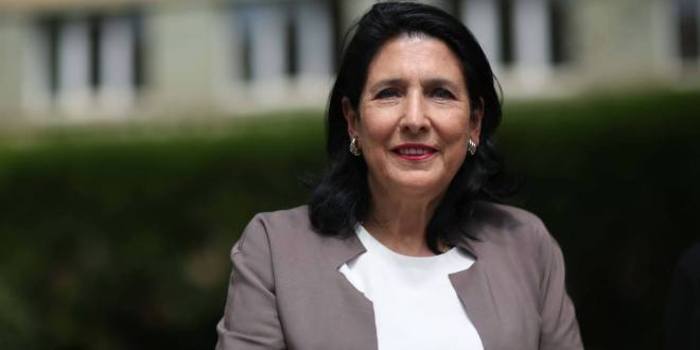
At a press conference on November 24, Georgian President Salome Zourabichvili said that she closely follows former President Mikheil Saakashvili's health daily during the House of Justice's presentation of the "EU Agenda, Justice Reform."
The President said that officials of her administration often meet with the council established to keep tabs on Saakashvili's condition, stressing that this is a severe problem for the country's reputation and Georgia's dignity. "Such a meeting is planned for today," she continued.
The President underscored that if there is such a conclusion, it should be brought to the Court. The Court should make a dignified judgment, despite the fact that she might not possess the required knowledge to do so herself. She said, "This will fix the problem in two ways. I feel that this is the most proper route, and I have expressed this many times overseas and at confidential meetings. The former president's health difficulties will be resolved. However, it will also ensure the Court's independence, which will be no less significant for the country."
She also stated her desire for the Court to approve such a decision if a medical evaluation of Saakashvili's condition reveals that he requires being transferred abroad, noting that it is likely the ex-President's attorneys who should make the proper legal claim in court.
Regarding depolarization in Georgia
The President of Georgia said that Georgia has neither strong institutions nor respect for institutions nor justice. According to Zourabichvili, agreement on justice reform is a way for Georgia to do what it does not know how to do - depolarization. The President noted, "The main thing is to reach a consensus, without which everything will be in vain."
"We did not expect the candidate application, the date was 2024, but nothing was ready for that yet, and it happened, and we should be grateful for that. Even today, the situation in Ukraine is very serious, the bombs do not stop, and also, today, the UN Security Council meeting was held, and it can be seen how serious this situation is. I want to honor the 27th Georgian who died in Ukraine. They fight of their own free will and are not representatives of the state, but they are representatives of Georgian dignity," she added.
"In these 12 recommendations, it is clear that justice and bringing this reform to an end is the main thing because it is the means, the way for us to get out of the Soviet system. There is no other way; everything else will be based on this. Protecting human rights, protecting business, setting European protection standards, combating discrimination, determining whether or not wiretapping is necessary," the President of Georgia emphasized.
"It does not apply to everyone, but it applies to some), establishing the inviolability of private property, that is, everything that we generally call democracy - everything goes through justice. If there is no justice, then nothing is protected. An agreement on justice reform is a way for us to do what we don't know how to do—depolarization. Not only do we not know, but no one knows, the European guidelines and requirements do not specifically say what and how to do, but it is clear that this means that we should be able to agree with each other on how to proceed with the reform of justice. The main thing is to reach a consensus, without which everything will be in vain because then we will not be able to agree on anything. This agreement means that all parties will be able to put the interests of Georgia before the interests of the parties. Very often in recent history, unfortunately, we have not been able to do this, which hinders us. This is the request, not because someone wrote it down in some recommendation or someone addressed us in this regard. This is ours to do. If there is no minimum consensus, the country cannot develop. Today, there may be polarization in other countries, and the same procedures are taking place there, but those countries are beyond that line; they are already in that democratic world, and for them, there is the main defense mechanism, which is the strength of institutions. They have dams that protect against any polarization so that it does not turn into something else. However, we have neither strong institutions nor respect for institutions nor principles, including justice. Justice is not a foreign fruit to us. It comes from the primordial Georgian traditions," Zourabichvili concluded.
Georgian Culture Minister: "Georgian President should share her stance over Saakashvili's pardon"
On the same day, Georgian Culture Minister Tea Tsulukiani said, "Georgian President should share her opinion regarding Saakashvili’s pardon instead of finding out what the court is doing."
"Within its purview, the court will handle its business. The public’s primary concern is whether the president will grant Saakashvili’s pardon; this is the key question. She took an extremely negative position, and I hope that this strongly negative response is still applicable," Tsulukiani added.