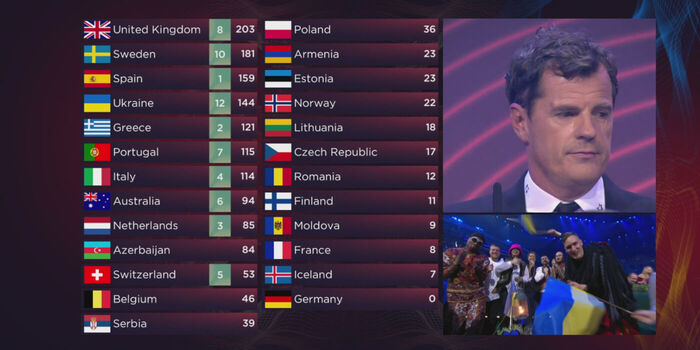
Eurovision organisers have admitted that they discovered "irregular voting patterns" from six nations and have already erased their results. The event's grand final was held in Italy, where Ukraine emerged victorious following an overwhelming popular vote. However, the European Broadcasting Union (EBU) openly said that the jury's votes from Azerbaijan, Georgia, Montenegro, Poland, Romania, and San Marino revealed "strange voting patterns." As a result, these votes were omitted in favour of "aggregated results," which were derived using the results of other nations with similar voting histories.
"After the Second Dress Rehearsal of the Second Semi-Final of the 2022 Eurovision Song Contest, several anomalous voting trends were found in the results of six nations," according to a statement from the European Broadcasting Union's pan-European voting partner. "The EBU considers any suspected efforts to rig the Eurovision Song Contest voting very seriously and reserves the right to withdraw such votes in line with the official voting instructions, regardless of whether or not such votes are likely to impact the voting results and/or outcome."
“Things happened during the final stage of the Eurovision Song Contest 2022 and decisions made after that were met with regret by Public Television and Radio Broadcasting Company of Azerbaijan (ITV),” the company’s press service told. "We declare that we have sent the names of countries for which the Azerbaijani jury voted to organisers of the competition. According to this list, Ukraine received 12 points. In response, the organisers of the competition asked representatives of ITV to announce other results after the end of the final show without substantiating this in any way. We categorically denied this request,” ITV said. “An official letter was immediately sent to organisers with a request that we would voice votes of our jury on the air, not the results received from them, and make this situation public. Only after that, we were informed that during the semi-final, which took place on May 12, some ‘oddities’ were found in the votes of six countries, including Azerbaijan. We were not informed of these ‘oddities’ from Thursday (May 12th) until the end of the final on Saturday (May 14th), and no ‘evidence’ has yet been provided,” ITV said. “Despite the fact that the representative of ITV was ready to announce the results of the voting of the Azerbaijani jury during the broadcast, organisers of the competition did not contact the studio in Baku and announced their results on our behalf. They linked inability to contact the studio in Baku because of technical problems,” the company noted. “However, we didn't have any technical issues with announcing the votes live. We emphasise once again that we did not give organisers any right to announce voting results on behalf of ITV,” the company added. “We are waiting for an official answer to this question and plan to take certain steps depending on it. We hope that the situation that has arisen will soon be resolved fairly," ITV’s statement concluded.