Armenia withdraws from meeting with foreign ministers of Turkey and Azerbaijan
The issue of holding a meeting of the foreign ministers of Armenia, Turkey and Azerbaijan is not currently on Yerevan's agenda, Vahan Hunanyan, press secretary of the Armenian Foreign Ministry, said. Thus, the Ministry of Foreign Affairs of the Armenian Republic distanced itself from the statements of Turkish officials about the work on organising said trilateral meeting.
“Yes, a similar proposal was made in Antalya (on the side-lines of the Antalya Diplomatic Forum on March 11-13), but, as you know, the meeting did not take place. And now there is no such issue on the agenda,” Hunanyan said, commenting on the statement of Turkish Foreign Minister Mevlüt Çavuşoğlu.
The head of Turkish diplomacy said earlier that Ankara plans to organise trilateral talks between the foreign ministers of Turkey, Azerbaijan and Armenia.
“We wanted to organise this meeting as early as the Diplomatic Forum in Antalya in March. [It d]id not work out. But the proposal remains in force, and Baku is not against this meeting,” Çavuşoğlu stated recently.
Azerbaijan appropriated the gas supply system of Karabakh region
The Azerbaijani company Azerigas has stated that it plans to reconstruct and improve the gas infrastructure in the Karabakh region. The official representative of the company, Teymur Jafarov, said that "certain repairs have already been carried out" on the gas pipeline going to Stepanakert/Khankendi.
“At the next stages, it is envisaged that the entire gas infrastructure of the Karabakh economic zone will be reconstructed and improved, including in the city of Khankendi,” the representative of Azerigas said.
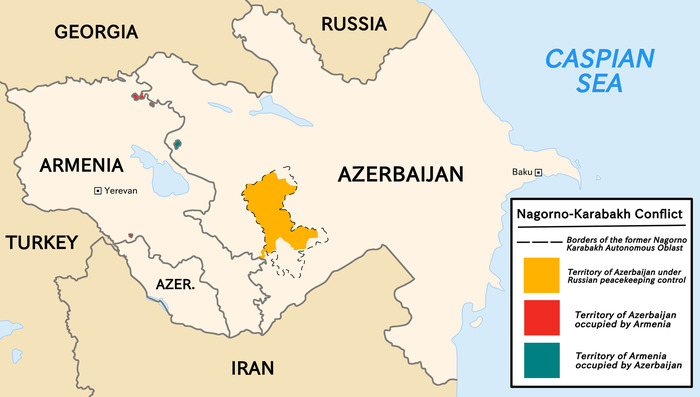
As the area has not been under Azerbaijani control for 30 years, gas supply to the region has been provided by Armenia. At present, apart from Stepanakert/Khankendi and some adjacent territories, Azerbaijan controls the territories liberated as a result of the Second Karabakh War. Gas supply to Nagorno-Karabakh was intermittent during the Second Karabakh War. However, 12 days after the tripartite ceasefire declaration signed between Azerbaijan, Armenia, and Russia on November 10, 2020, gas supplies to Stepanakert/Khankendi resumed.
Armenia still provides utilities, including gas, to ethnic Armenian communities. According to the Armenian media, most of the pipeline supplying gas to ethnic Armenians in Nagorno-Karabakh was laid "parallel to the Lachin corridor.”
The other part of the gas pipeline passes through Shusha and enters Khankendi. Although there is no exact figure for the length of the pipeline, given that it is parallel to the Lachin corridor and passes through Shusha, then the section of the gas pipeline from the Armenian border to Khankendi/Stepanakert is about 80-84 kilometres. As a result of the 44-day war between Armenia and Azerbaijan two years ago, part of the gas pipeline came under the control of Azerbaijan. This area covers the part of the pipeline from the lower parts of Shusha to Stepanakert/Khankendi.
The Armenian side claims that after Azerbaijan regained control over those territories, it "installed a crane" on the gas pipeline and can "close" it at any time. Official Baku denied the allegations, saying that the prolongation of the pipeline's repair process was due to "corrosion of the long-used pipeline and gas leaks due to landslides."