After Russian President Vladimir Putin convened trilateral meetings in Sochi, the presidents of Armenia and Azerbaijan showed a desire to make progress on border delimitation and expanding commercial and transportation linkages.
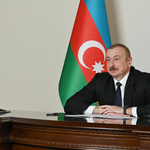
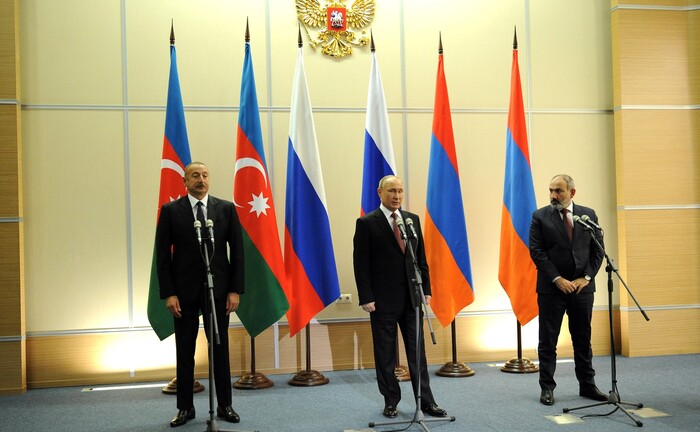
On November 26, Azerbaijani President Ilham Aliyev, Armenian Prime Minister Nikol Pashinyan, and Russian President Vladimir Putin began their three-hour meeting by saying that "a lot has been done" since last year's Moscow-brokered cease-fire ended 44 days of intense fighting over Nagorno-Karabakh and nearby districts.
Fears of a return to large-scale violence have been reignited following a tragic flare-up last week.
In a statement after their talks, all three pledged "to take steps to increase the level of stability and security on the Armenian-Azerbaijani border and to work towards the creation of a bilateral commission on the delimitation of the state border between the Republic of Azerbaijan and the Republic of Armenia with its subsequent demarcation with the consultative assistance of the Russian Federation at the request of the parties."
They also vowed "to intensify joint efforts aimed at the earliest possible resolution" of commitments from the past year on resuming economic and transport links in their Caucasus region.
Moscow said it would lend "all necessary assistance" toward "normalising relations" between the long-time foes and "creating an atmosphere of trust" between their peoples and "building good-neighbourly relations in the region."
Putin said that Russian, Armenian, and Azerbaijani deputy prime ministers would meet in Moscow next week "to summarise some results and announce the decisions that we have coordinated today."
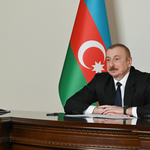
Aliyev expressed hope that the Sochi talks could lead to a "more secure and predictable" situation in the Caucasus.
“Today we had a very detailed and I would say frank conversation on issues of border delimitation and demarcation and unblocking of transport arteries," Aliyev said.
"We openly discussed our plans, we openly discussed issues that cause concern with both sides. The most important thing is that the decisions that we’ve made in the issue of settling disputes, differences will contribute to a more secure and predictable situation in the South Caucasus."
Aliyev said that "in Azerbaijan, we feel like turning over the page of many years of confrontation with Armenia and begin a stage of normal interaction," adding, "I think our meeting will lead to good results that won’t make us wait for too long."
Pashinyan described the meeting as "very positive."
"This wasn't a meeting to hide problems," the Armenian prime minister said. "I think that we can expect concrete results if we manage to build on the dynamics of our talks."
Last year, Azerbaijan took control of large swathes of land in and surrounding Nagorno-Karabakh, a breakaway Azerbaijani area that had been under ethnic Armenian authority since a brutal war in the 1990s.