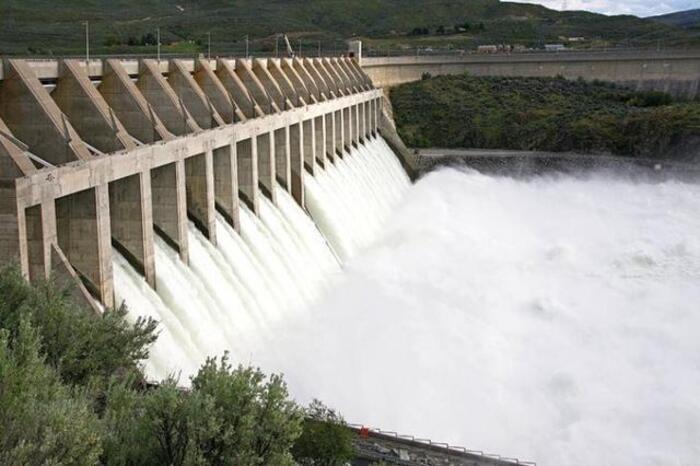
On 27 May, the protesters who are demanding (Caucasus Watch reported) the stop of the Namakhvani hydropower plant (HPP) construction moved from Tbilisi to the village of Gumati to continue their actions.
The Georgian Ministry of Internal Affairs (MIA) stated that the protesters were hitting the iron barricades erected by the police all night long, for 6 hours, and stopped the noise only in the morning. In turn, the MIA launched an investigation into the fact of “damaging metal barricades set up by police for security reasons.” The police have mobilised a water cannon vehicle on the ground.
Earlier, the organiser of the rally, Varlam Goletiani, said that the “guardians” were going to close all the entrances to the valley and restrict the movement and continuation of work for the vehicles of the HPP construction company.
Georgia’s Economy Minister Natia Turnava responded to ongoing protests saying that the government is ready for “meaningful dialogue.” However, she added, dialogue on this issue will be very difficult if the streets are blocked and paralysed.
In the meantime, the media outlet “Mtis Ambebi” (Mountain News) obtained a report made by the Ministry of Justice in March 2019, which negatively assessed the Namakhvani HPP agreement, emphasising that there were 22 critical notes on the project. The outlet claimed that the report would expose the country’s Prime Minister Irakli Garibashvili, who in response to the protests had instructed the Ministry of Justice (MoJ) to evaluate the contract (Caucasus Watch reported).
The leaked report criticises the government’s obligation under the contract to compensate the company in the event of a force majeure. According to the MoJ, most of the force majeure circumstances related to the obligation to compensate are not under the control of either party and are not caused by the fault of either party. Therefore, the MoJ points out that such “unforeseen circumstances” should not be “used as a mechanism for punishing a party [government].” It is unacceptable for the MoJ that financial responsibility for such circumstances lies with only one party to the contract – the Government of Georgia, in favour of the company.
The MoJ is also critical of the unequal record, which in the event of a political force majeure, completely relieves the company of its obligations, while leaving the obligations of the Georgian government and other public institutions in full force. The conclusion of the Ministry of Justice is particularly critical of the government’s commitment to “high-risk” financial commitments, assuming that these commitments are incumbent on the government for an unreasonably wide circle of stakeholders in the project.