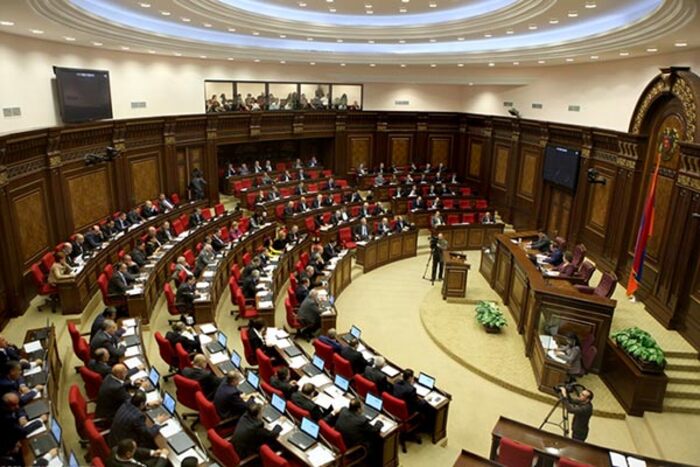
On 24 March, Armenia’s National Assembly lifted the martial law in the country, which started on 27 September 2020 with 118 votes in favour and 1 against.
The motion was submitted by the two opposition parties represented in the National Assembly - Bright Armenia and Prosperous Armenia. The deputies of the opposition parties argued that the martial law was no longer necessary after a Russian-brokered ceasefire that stopped the Second Nagorno-Karabakh war on 10 November 2020.
This was not the only important change adopted in the country’s parliament, as the National Assembly also passed the draft law On Anti-Corruption Committee (ACC) which would replace Armenia’s Special Investigative Service (SIS). According to Armenia’s Justice Minister Rustam Badasyan, the ACC would combine investigative and operational-search functions, which are expected to help increase the efficiency of the investigation of corruption crimes. ACC members cannot belong to political parties or engage in political activities. The ACC would also become the second law enforcement body in the country after the Commission for the Prevention of Corruption which investigates corruption crimes.
While speaking to the parliament, Armenian Prime Minister Nikol Pashinyan stated that the snap elections, scheduled for 20 June, would be held under the proportional system (by party lists). He has spoken in favour of introducing “simple changes” in the country’s election-related laws before holding early parliamentary elections. Pashinyan stressed that holding early elections under the current or new electoral code was not part of the political agreement reached with the parliamentary opposition. “During all our discussions I asked our colleagues, including in parliament, about what they think about the voting system, in other words, whether they think that the rating system should remain or should be scrapped. During our discussions we registered that both the Prosperous Armenia party and the Bright Armenia party leave this matter to the discretion of the parliamentary majority,” he added.
The parliamentary deputy from Pashinyan’s My Step faction and the chairman of the Standing Committee on State and Legal Affairs Vladimir Vardanyan also said that Council of Europe Venice Commission decided to consider with an urgent procedure the issue of the packages proposed in the electoral code of Armenia and to submit a conclusion by 20 April. According to Vardanyan, the expected changes in the electoral code would simplify the electoral system of Armenia. “We are not talking about a new electoral code, but about certain amendments to the current electoral code, which do not complicate the electoral system, but simply try to clarify them. The electoral system will not be able to influence the registered result in any way,” he added.