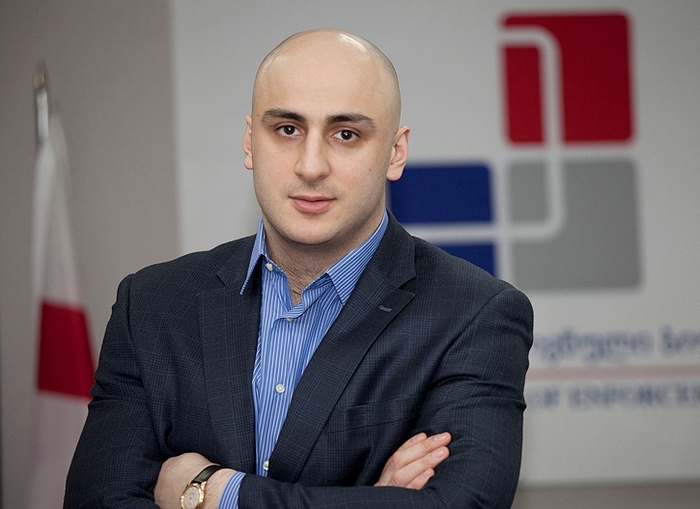
On 16 February, the Georgian parliament suspended the mandate of the leader of the opposition United National Movement (UNM) party Nika Melia after the request of the Prosecutor's Office (Caucasus Watch reported).
The parliament voted with 88 votes in favour of the motion and 2 against. Hours before the vote, Georgian Public Defender Nino Lomjaria advised the ruling party against stripping Melia of his immunity. Lomjaria argued that 18 months since the initial indictment, preventative measures against Melia were not in the interests of justice.
Following the decision, the UNM announced that it would counter Melia’s arrest even at the cost that the “regime would have to attack the UNM office with special ops.” A protest was held outside the parliament by the UNM supporters who brought barbed wire in front of the building.
As for Melia, he announced rallies for the 25 February following the decision. “We decided to hold a peaceful demonstration on February 25, a day when the Soviet Union managed to make our country soviet 100 years ago. 100 years later, Georgia still faces the same challenges and threats that we faced 100 years ago. Unfortunately, this threat could not be neutralised then. If we do not want to make the same mistake and solve the problem we are facing, we should hold a peaceful march-demonstration in Tbilisi and Batumi,” he said adding that another rally would take place on 31 March.
Melia was also furious towards the leader of the Citizen’s party Aleko Elisashvili, who offered to transfer money to Melia so he could pay bail. “Do not make me come to the parliament, Aleko. I will take you out of there with my own hands!” Melia said, adding that whoever pays the bail in his place would be an agent of the State Security Service of Georgia and a supporter of the Russian parliamentarian Sergey Gavrilov, who was the trigger of the 20 June protests in 2019 (Caucasus Watch reported).
Speaking on Gavrilov, he stated a day earlier that the ruling Georgian Dream (GD) party was “doing its best to prevent coups, repressions and dictatorship in the country,” following the 20 June events. “We are ready to support the free choice of the Georgian people in favour of independence and sovereignty. One of the goals of the opposition and those participating in the coup is to complicate Georgia’s relations with its possible partners in economic, spiritual and cultural issues, discredit Georgia as much as possible, and cut it off from its friends. The lies told by Nika Melia when interpreting the June 20 events proves that they are trying to damage Georgia’s image in the eyes of its neighbours,” Gavrilov told the Georgian TV channel Pirveli.
The Russian MP pointed out that after overcoming the pandemic, the Georgian parliament should establish direct relations with the parliaments of Russia, Armenia and Turkey, and not only with the United States, in order to form the “normal multi-vector, multipolar position of sovereign Georgia.” Melia responded to Gavrilov’s statements and said they were “a direct directive for the GD to continue the repressions” in the country.