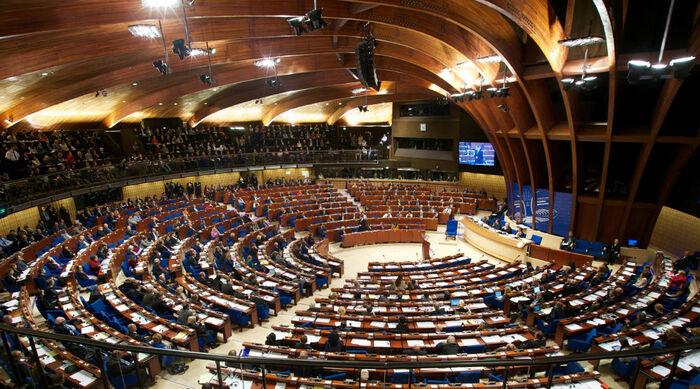
On 26 January, the Parliamentary Assembly of the Council Of Europe (PACE) discussed the current political issues in the South Caucasus, including the political deadlock in Georgia and the post-war situation in Nagorno-Karabakh.
In its annual report, PACE said that it was “regrettable” that Georgian opposition parliamentarians refused to take up their mandates, adding that “in the best interest of the country all political parties are urged to take up their parliamentary mandates.” “Regrettably the opposition parties, alleging widespread fraud, announced that they would boycott the second round and the new parliament. This is especially regrettable given that the results for opposition parties in these elections would give them a strong position to execute parliamentary oversight. Parliament is the place for the conduct of politics and debate and the Assembly has therefore consistently opposed parliamentary boycotts. In the best interest of the country all political parties are therefore urged to take up their parliamentary mandates,” the report read.
In relation to Georgia, the report also raised concerns over the situation in Tskhinvali (South Ossetia) and Abkhazia. “The situation around the de facto occupied Georgian regions of South Ossetia and Abkhazia has continued to deteriorate, as the creeping annexation of these regions by the Russian Federation continues unabated, which is of serious concern. As a result, contacts between Georgians inside and outside these two regions has become practically impossible. This has severe humanitarian consequences, as it has become increasingly more difficult, if not impossible, for inhabitants in these two Georgian regions to cross the administrative borderline for schooling or for (emergency) medical reasons in the rest of Georgia,” the report elaborated.
In relation to the post-war situation in Nagorno-Karabakh, PACE called on Armenia and Azerbaijan to refrain from rhetoric that hinders political dialogue and implement the provisions of the trilateral agreement on Nagorno-Karabakh as soon as possible. The Assembly also recommended that the exchange of prisoners of war, respect for the cultural heritage, and refraining from rhetoric that interferes with political dialogue be started immediately. A serious concern to PACE were also the reports of violations of humanitarian law and human rights during the conflict in Karabakh, along with information about the damage caused to religious sites, monuments and private property.
The internal political developments in Armenia and Azerbaijan were also mentioned. In Armenia, the progress in Transparency International’s Corruption Perception Index, 2020-2022 police reform strategy which foresees the establishment of a Ministry of Internal Affairs in the country, as well as the ratification of the Convention on Protection of Children against Sexual Exploitation and Sexual Abuse were praised as major achievements. On the other side, the current political crisis in the country and the conflict between the country’s Prime Minister Nikol Pashinyan and the Constitutional Court were classified as concerning issues.
As for Azerbaijan, the release of 76 prisoners aged over 65 in need of special care due to their age and state of health during the Covid-19 pandemic, as well as the release of Azerbaijani investigative journalist Afgan Mukhtarli were praised as positive achievements. Reports of large-scale repression of government opponents and restrictions on freedom of expression, including internet access, under the pretext of safety measures against the Covid-19 pandemic was one of the report’s concerning issues. The lack of independence of the country’s judiciary and Azerbaijani authorities’ non-enforcement of the European Court of Human Rights’ judgment regarding the annulment of the court sentences against the Head of the Republican Alternative Party Ilgar Mammadov, and seven other activists, which prevented them from running in the parliamentary elections in the country, were also highlighted as the concerning issues.