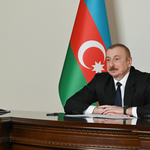
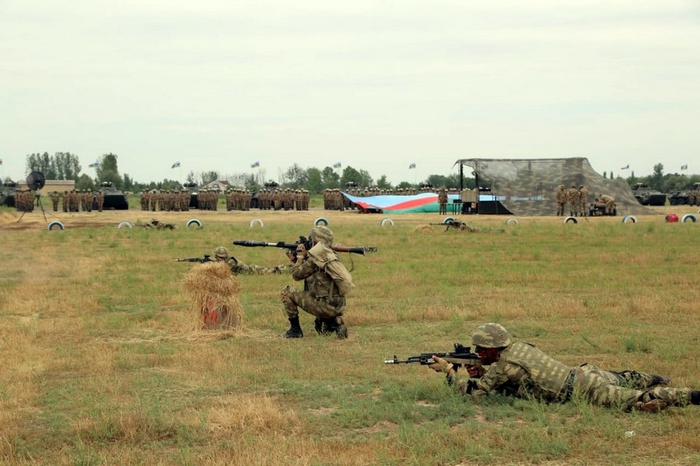
On 20 May, a large-scale operational-tactical exercise of the Azerbaijani army held under the leadership of Azerbaijan’s defense minister, Colonel General Zakir Hasanov, had started. The exercises are expected to be conducted until 24 May.
According to the Ministry of Defense of Azerbaijan, the main objective of the exercises is to train repealing the enemy’s attack at night by delivering counterstrikes to the enemy’s positions in various directions and launching the Azerbaijani troops’ offensive operations. The exercises involved up to 10,000 military personnel, 150 tanks, other armored vehicles, up to 200 rocket and artillery mounts of different caliber, multiple rocket launch systems, mortars as well as up to 35 aircraft and helicopters.
The state officials in Armenia consider the exercises to be an act of aggression by Azerbaijan. The spokesperson of the Armenian Ministry of Foreign Affairs, Anna Naghdalyan, warned about raising the issue to the OSCE. “The holding of military exercises by Azerbaijan without any prior notification is a violation of the country's commitments to the OSCE, which does not contribute to peace and confidence in the region. Naturally, this issue will be raised by Armenia's permanent mission to the OSCE”, she said.
The large-scale military exercises of Azerbaijan take place in the context of the political tensions in Armenia. On 20 May, Armenian prime minister Nikol Pashinyan accused his domestic opponents of planning to provoke a war with Azerbaijan, which could lead to territorial losses. This would allow the old political elites of Robert Kocharyan and Serzh Sargsyan to scapegoat Nikol Pashinyan’s government. According to Pashinyan, such activities are equivalent to treason.
Armenian defense minister, Davit Tonoyan, then said that such a scenario was impossible in today's Armenia and that he would not allow such an attempt. However, he did not exclude that it could possibly come to fighting with Azerbaijan "for various reasons". Azerbaijani minister of defense, Zakir Hasanov, for his part, ordered the "immediate suppression of all hostile provocations", if necessary using all available types of weapons.
The Nagorno-Karabakh conflict is a long-lasting territorial and ethnic conflict between Armenia and Azerbaijan. The Nagorno-Karabakh region belongs to Azerbaijan under international law, but it is occupied by Armenia, which sees itself as a protective power for the Karabakh-Armenians. The OSCE Minsk Group under the co-chairmanship of Russia, France and the USA, has been mediating since 1994 in the search for a peaceful resolution to the conflict. Success has not yet been achieved.