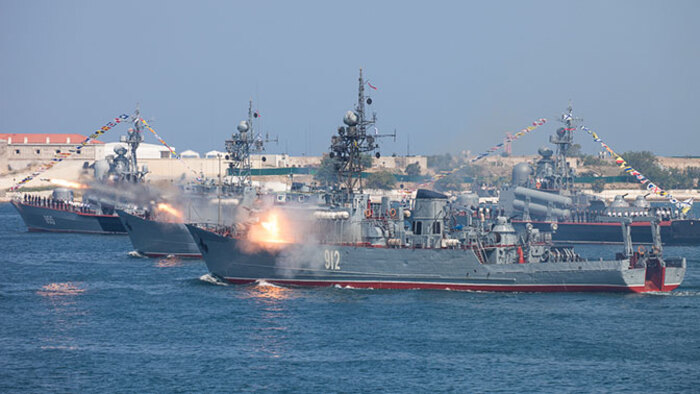
Russia conducted naval exercises in the Black Sea

Russia conducted naval exercises in the Black Sea

Warships of the Russian navy entered the Black Sea today to conduct warfare exercises and training tasks, Vestnik Kavkaza  reported.  

"The warships of the Black Sea Fleet left their home base to join the fleet group in the Black Sea. The detachment of ships sailed to predefined areas where it will control and monitor the situation underwater, above the surface and in the air", reads the statement of the Russian Black Sea Fleet.

Amidst the training ground, ships of NATO's Sea Shield naval drills were also present. The Russian ships returned to their home base after the exercise. The official statement of the Russian Black Sea Fleet pointed out that “the NATO Sea Shield 2019 drills were a good support for the Black Sea Fleet forces in practicing their warfare skills under real-world conditions".

The Sea Shield 2019 is an annual Romanian-led naval exercise conducted by NATO. The alliance conducts exercises in the Black Sea since April 5th 2019 and these include more than 20 Romanian, Turkish, Bulgarian, Canadian, Greek and Dutch ships.

For a deeper insight into the security dynamics in the Black Sea, click here. 

5591 Mal angesehen

ARTICLES IN ENGLISH»


MEISTGELESEN


AKTUELLES


OPINION


Call for Contributors: Caucasus Watch is looking for experts, journalists and fact-checking specialists!

“Caucasus Watch” is seeking local specialists from Georgia, Armenia, Azerbaijan and the North Caucasus region, to assist our research endeavours and help enrich our content.

“Caucasus Watch” is an independent platform, which provides coverage of recent developments in various locations of the Caucasus region for the German and overall European stakeholders. We are an international team of Caucasus enthusiasts and are currently looking for local contributors who focus on social, economic, political and security dynamics of the said region.

The platform offers: I) a flexible format of cooperation, as well as competitive remuneration; II) access to English and German speaking readership in the wider European region; III) an opportunity to join the network of regional specialists through the initiatives and events to be organized by the Caucasus Watch and partner institutions.

Interested individuals are asked to provide a CV and a cover letter along with an abstract or a writing sample (in English or German), to the following address: redaktion@caucasuswatch.de.

Additional questions can be directed to Igor Dostalik through: i.dostalik@caucasuswatch.de.